Publishers

Showing posts with label Legendary Games. Show all posts

9/24/2008

Legendary Game : Spore (part III)

Part I or Part II

A few hiccups


Apart from what I think is a skewed game mechanic, the game falls short on a couple of other counts. What I'd have really liked to see is a simple feature called auto-save -- that is not too much to ask for in a game. Although 'death' in the game is of little consequence, an auto-save feature was sorely missed when the game crashed on more than a couple of occasions and I found restarting that stage of evolution all over again. Spore obviously has a save feature; however, the creation tools and the world can be so engaging that you miss to save your game. Some gameplay aspects feel too easy and simple, reaching Armageddon was never so easy, although it's addictive to expand; the civilization phase seems too short. In Space phase, you can't save a game if you are on a planet, one has to exit a solar system to save the game, and the game does not convey as much. Then there is the DRM issue -- you can read about that can of worms here. These are some of the flaws that I hope will be fixed through future patches.

The game is well designed with many amusing add-ons. Funny voice effects and amusing antics by the creatures are found throughout the game. The game looks good, for what it sets out to do, and the interface is smooth. Visually, the game looks perfect for its content.
A few nifty multiplayer features have also been built into the game, mainly encouraging sharing and flaunting of your creations. While in the creation mode, the game automatically captures frames at each stage and creates an animated forum avatar that'll let you show off how you went from that simple block to the uber-cool space ship. The 'My Collections' feature of the game is a repository of your creations and collection that you can share over the Internet. Additionally, you can create videos of your creature in action and upload it onto YouTube from within the game. I am guessing that there are more features that'll emerge after further exploration and hopefully through updates and patches.

As it stands right now, Spore offers a Petri dish, a sandbox, a snow globe -- you can pick your analogy. If you are looking for deep strategic options, you'll find this game wanting. For those who enjoy building things, the game will offer you endless hours of fun (unless the dreaded DRM decides otherwise) and take you back to the days of playing with Lego blocks and play-dough. If you are looking from more 'traditional' form of game play, skip directly to the space exploration stage where creation takes a back seat in the game. This game is a true masterpiece in my opinions and it is one of those masterpieces that brake the mold and fire fresh imagination .

Legendary Game : Spore (part II)

Part I

Civilization Phase can be quite challenging because you have to capture the entire planet. You start off by designing the city, the factories, the houses as well as the combat vehicles. I designed my very own Metal Gear Spore and a Spore 22 Raptor as well as my favorite -- the Sea Santa. These vehicles are necessary to acquire Spice, which is the main currency. Spice can be found gushing out of land and sea. You have to plan out your city, which includes creating a house and factory model in the editor.


Building a house increases the vehicle cap, while building factories increases the revenue. It's up to you to keep a balance of both and make a profitable empire. Once you have enough resources, you need to start capturing cities. Every new city you capture will unlock a new feature. You will eventually be able to create sea and air vehicles, which are absent at the start. Capturing new cities also unlocks various super weapons including one which nukes all the other cities. The city planning and resource management aspect of the civilization phase is quite addictive; you want to advance fast and nuke even faster.


At the end of the civilization stage and depending on your choices, your species will now have enough economic and/or muscle power to develop space technology and you set out to find other sentient beings in the vast universe of Spore. It's fairly easy to go from a single-celled organism to a dominant space-fairing species, in a matter of three to four hours.

The final frontier


The Space Phase starts off with you building a spaceship. You use the spaceship to scout your planet, learn about the various creatures, and do some simple tasks to get used to the controls and so on. One of the tasks includes tractor-beaming up a creature and bringing him to any of the cities: reminiscent of the time you were the creature. Your progress during the space stage is significantly slowed down; the ultimate goal is to travel to the center of the universe.


In Space stage you can explore other planets, some of which are created by other users, interact with their creatures and lean more about them. The space phase is vast and you can explore the 500000+ planets in the game's galaxy. A user-created planet and its AI borrows traits off its creator's style of play: if the creator is aggressive, the AI will be aggressive. You can make allies like in the tribal phase or launch an inter-galactic war. The Space Phase is never ending; you can keep exploring deeper and deeper, and keep interacting with the ever increasing world of Spore.


Up until this point, Spore is dominantly about playing an architect and you'll likely spend the bulk of your time within the cleverly crafted creation tools. Once you enter the space stage however, it begins to feel more like a game and also compels you to drastically rethink your strategy. This brings us to the difficulty balance of the game.


To test the game mechanics, I experimented with different levels of aggression. One of my creatures was an aggressive carnivore and I found the going got really tough at the civilization stage of the game. Alternatively, I created an herbivore creature that befriended, impressed and bought off others to breeze into the space stage of evolution. Maybe it's just me, but I found that my passive ways forced me to be submissive to the more aggressive species of the universe. With limited military might, our economic dominance at the home planet offered little help to counter the opposing forces of the universe. Running helter-skelter between fighting off raiding space pirates, retaliating against aggressive species, and preventing biological disasters -- my aspiring space marine found little time to do what I wanted -- peacefully explore, colonize and build inter- planetary trade routes. At this stage, you do have a choice to refit or upgrade your spacecraft with more destructive force, but I was disappointed to find myself in a situation where I was forced to take a certain path.

Part III

Legendary Game : Spore (part I)

After nearly eight years in the making, the world saw the release of Spore from Will 'Toy Maker' Wright's Maxis studio. Spore has been touted and speculated as a god game or a simulation of everything; however, in our humble opinion it's neither a game nor a complete simulation, at least not in the strictest sense of the words. What Spore offers is an opportunity for a controlled experiment in nature, or evolution if you will.


Speaking of evolution, the game tends to throw our traditional understanding of the Darwinian theory of 'survival of the fittest' out the window as you have fair amount of choices to ensure your species survival and dominance in the universe. Having said that, the game design doesn't stray too far from our understanding of evolution and offers the progression stages starting with a single-celled organism all the way to what we may consider peak of a civilization -- space exploration.

Starting your journey


Your creature's journey in Spore begins as a humble single-celled organism, whose sole purpose in life is to consume and multiply. Determining your creature's traits at this stage are two main factors -- your dietary preference (plant-eating, carnivore or omnivore) and your survival tactics (aggressive, passive or adaptable).

This Cell Phase is basically a top-down view of your creature eating and growing on a 2D surface. Since I was an herbivore, I was swimming around looking for plants to chew on. As you eat, a progress bar at the bottom of the screen will track your progress to the next phase. You will have to keep your distance from other carnivores -- since to them, you are on the menu. Occasionally you will discover useful body parts that can be used by you inside the game's editor: such as a spike on your back to hurt those pesky predators.


Irrespective of the means you choose, the end entails making your creature's DNA complex enough to grow 'legs' and move on to the land above. Before exiting to land and entering the Creature Stage you are given a special ability, to survive in the outside world. I was given the Siren Song, for example.


With similar choices offered at the Creature Stage, your main goal is to collect more complex body parts that you will use to enhance your creature through an incredible fun and simple to use tool kit. In this phase, the game will also generate species around you, to balance the ecosystem. The world around you is thus filled with many different creatures; you will also find many dead animals as well as skeletal remains. These skeletal remains can be scourged to discover new parts that can be later used in the editor.

Do the dance


The Creature stage of the game ends with the consequence that your creature will emerge as the dominants species in the world, right at the top of the food chain. Since you are the only sentient species on the current planet, the power struggle shifts to intra-species strife for domination or survival.
At the end of the tribal stage, the biological blue print of your creature will be set in stone and the way forward at this stage is through collection and implementation of various tools that'll lead you through to the civilization stage. The game introduces balance by spawning bigger and stronger creatures around you. I turned into a carnivore after a while by editing and adding a new carnivorous mouth piece. I realized that as an herbivore I was very passive and harmless, hence was hunted quite easily. A few modifications later -- I got me an offensive bite ability as well the ability to sprint -- attributes of my new-found body parts.


In the creature phase one can earn DNA points by either eradicating other species -- this is done by killing 5-7 members of the species, or by being friendly and impressing 3-5 members of that species. It's your decision, and as you complete the tasks your progress bar grows towards the next Phase.

An interesting anecdote: During one of my hunts, I saw a huge herd of creatures running away, after a while I heard a strange noise and before I could comprehend, I saw a giant spaceship looming overhead. I was quite shocked and not knowing the ship's intentions, I fled. The ship started abducting many creatures and after a while, it just flew away. I saw a couple of creatures waving at the ship with gloomy faces, as the ship had abducted one of their own.

Every time you are ready to evolve and add new parts to your creature, you have to mate. The creature phase can be quite action-packed if you are a carnivore. After earning a decent amount of DNA points your brain gets bigger and you can now add a member to take along on your adventures. In plain language, you start a pack. You can make allies by singing to others: a small mini-game starts and if you are able to impress, you win an ally. This socialization is not limited to singing and there are other abilities like charm and dance which are earned depending on the body parts you use in the editor. However, a tribe might demand you dance for them to become allies -- whenever one asked me to dance, I eliminated their entire species. I remember earning an achievement (yes the game has achievements) as I eliminated about 20 species to earn DNA points.

Once again, at these stages of the game -- starting from your arrival on land to the peak of your civilization, the course of the species is determined mainly by how you use your acquired technology and your social interaction with other species, tribes and civilizations.
In the tribal stage your goal is to grow as a tribe and dominate others. You start off by hunting and collecting food. Once you have enough food, you have to produce more babies and increase the size of your tribe. More food leads to more development, which can be used to create tools. These tools can be used for making allies or for eliminating rival tribes. I faced five tribes, I dominated and captured 4 of them and made the last remaining tribe my ally. Every time you eliminate or become allies with a neighboring tribe you receive their tribe Totem to indicate your victory. Once all the tribes have been defeated you get to advance to the Civilization Phase.

Part II

9/13/2008

Games of Legend : Planescape Torment

When you've got a storeroom full of great RPGs behind you, you've got to imagine that it's pretty hard to keep convincing yourself that the next one is going to live up to the great expectations that have already been set. Fortunately, rather than resting on the laurels they received for Baldur's Gate and the Fallout series, Interplay has taken the winning qualities of those titles and mixed them with a universe that is far different from what most RPG fans are used to. The end result is a game that has the playability of Baldur's Gate (which is no surprise, it uses the BG engine after all), the story and character depth of Fallout and Fallout 2 and an adventure that doesn't fall prey to the predictability that plagues so many games of the traditional fantasy genre.

As I stated above, a lot of the game's originality comes straight out of the Planescape world itself. For those of you who aren't on TSR's mailing list, the Planescape universe was created to allow deeper exploration of the various planes of existence that showed up in the earlier AD&D rules. There are a whole lot of different planes, and in the interest of getting this piece done sometime in the next century, I'm just going to let the game introduce them to you. Let's just leave it at this ¿ there are a lot of different attitudes out there and most of them have a plane of existence associated with them. Within these planes are major powers (gods, devas, etc.) who help keep them running the way they should. The city of Sigil, where a good deal of Torment takes place, acts as a sort of intersection for all of these different worlds. What this means is that as you stroll down the city streets, you'll be just as likely to spot devils and demons (they actually have more specific racial names, but once again I think the game itself will do a better job of explaining this out than I will), walking suits of armor, creatures of pure order, or other magical constructs as you will to spot human beings. If you're familiar with the concept of planar travel already, you're probably salivating at the basic setup here. If you're not familiar with it, let me reassure by saying that the game spends a lot of time making sure you understand the concepts involved by immersing you in them. In other words, it's fun to figure this stuff out and I'm going to move on now...

Main Character - The Nameless One

As you can imagine, this kind of backdrop was a dream for the guys who were designing the game. I mean, how bad can a story be if it can involve literally anything you can dream up? Even so, the guys over at Black Isle went all out when writing Torment's tremendous storyline. As the game begins, your character wakes up on a marble slab in the basement of a huge mortuary. Shortly after you wake up, you discover your first travelling companion, a floating, disembodied skull named Morte. Once you team up (Morte acts as a sort of floating encyclopedia for you), you'll start to discover what really sets this game apart from other titles you've played before. First off, you can't remember who you are. While it becomes obvious to you fairly quickly that you've played an important role in a great number of lives (you keep running into people who are really pissed off at you), you have no memory at all of who you are, what you've done, and what you're supposed to do now. The next thing you'll realize is that you're immortal. Unlike most games that end when the main player dies, in Torment you simply find yourself waking up again and again on the same Mortuary slab. While this is certainly preferable to dying, it can be a real bummer when you've traveled pretty far afield. Your power over death seems to extend to others as well ¿ you have an innate ability to raise any of your companions from the dead. Finally, even in a world where the extraordinary is commonplace, everyone in the realm of Sigil keeps treating you like you're some sort of freak. The repeated verbal jabs you take from the citizens you run across make finding out who you are and how you got to be that way a very compelling goal indeed.

Fortunately, your brain blank doesn't seem to be complete. Every so often, you'll see a person, place or action that seems familiar to you and it will trigger a flashback that will restore some of your earlier abilities and skills. It turns out that over the years you've done just about every job under the sun, so taking up any profession (read: character class) is really just a matter of remembering what skills you can. In gameplay terms, this is particularly cool, because you never really have to nail down and choose a particular profession. You start the game as a low-level fighter, but within a couple of hours you be able to switch over to thief or mage. If you decide at some point that that's not the way you want to play the game, all you have to do is switch back and you'll pick up where you left off on the experience scale.

Obviously, if you ever want to be good at anything, you'll have to settle down and actually earn some big experience in one of the different professions. The really cool thing about this is, like Fallout and Fallout 2, the game is written so that any type of character will have their own specific way to get through each of the different situations presented. More intelligent characters will be able to talk or magic their way through a situation, charismatic characters will be able to charm their way through it, quick characters might be able to flee or steal their way around the problem and strong characters... well strong characters will just beat their way through it. This setup not only offers a more realistic gameplay experience, but also imparts a certain replay value to the game ¿ if you've played through as a thug, you can try again as a wise man and will have a very different play experience than you did the time before.

Even though your character will always be the big freak in the party, some of the other players you pick up during the course of the game are pretty hardcore as well. I really kind of ruined the game for myself by knowing a lot about these different beings before I started playing the game, so I'm going to leave out the heavy character descriptions here. Let's just leave it at a succubus who's given up sex, an animated suit of armor with a Batman-like obsession with Justice, a rat-tailed girl who can trade insults with the best of them (the best of them would be Morte) and a weird critter from the planes of order. This is just a sampling of the different types of characters you'll find yourself travelling with, but I'm going to stop there. It's almost impossible to even talk about some of the different characters in the game without giving away parts of the game, so I'm just going to leave it alone. All you really need to know from a review standpoint is that all of the characters in the game are extremely well designed and have loads of speech, history and personal flavor. Better still, they have their own agendas and will respond quickly to changes in your alignment or deviations from the path of action that they deem most important. I also liked the fact that certain player characters have powers that, like your raise dead ability, are a part of the character design itself and don't really fit within the rigid AD&D rule set. My favorite was Morte's insult ability that would make any enemy on the screen ignore anyone else in an effort to kick his cranium. Not only was this power useful (sometimes you need a little space to cast a spell), but it was also pretty funny as well. Even more amusing was the fact that every time an NPC said something nasty to me while Morte was around, he would cackle with glee and add the new taunt into his already awesome catalogue.

Succubus

Obviously the characters you travel with have the most conversational text, but Planescape's NPCs boast a good deal more than you see in the standard RPG. A great deal of your game will be spent interacting with people trying to gather as many facts about yourself and the world around you as possible and it's nice to have townpeople who can offer up more facts than the standard, "Things used to be better before the Demon King invaded our realm." While this depth is one of the things that kept me glued to my screen, hack and slash players may get bummed out at the fact that Planescape is a lot more about character interaction than it is killing bad guys. On the other hand, I did have some troubles with major characters who play a important role in the game having a really short fuse. If you screw up a conversation, you may find yourself having to kill someone who could make your journey a lot easier. Still, even this is fairly realistic within the confines of the game. Planescape is a tough universe and nosy people who go around asking too many questions are very likely to find themselves in a fight.

Baldur's Gate fans will find the Torment interface just as easy to use (if not easier) than the original engine that it was based on. The game uses the same point and click system that finally convinced me that an RPG could exist in real-time and still be fun. All of the rules you'd expect to see in the pen and paper game, from encumbrance to casting time are in there, but handled by the computer without bogging down the game's pace. Like Baldur's Gate, all of the characters and NPCs in the game are surrounded by glowing circles that help you sort out your enemies from neutrals and comrades. While combat is relatively hands-off (you just point and click), loads of nice features like special animations for critical hits hold your interest pretty well and keep battles from ever becoming a chore.

I'm really running long here, but I feel like I have to say something about Torment's incredible art before I finish things up. When I first heard (all those years ago) that Interplay was planning to try and recreate the Planescape universe in a PC game, I was pretty convinced that they were doomed to failure. I couldn't have been more wrong. Black Isle has taken the point of view used in Baldur's Gate, but zoomed in close so you can see the characters a little bit better. And there are a lot of characters. The real reason I thought that no one would ever be able to truly recreate the Planescape universe was the sheer number of different models that they would have to create to show off all the different types of beings you would be able to interact with. While Torment doesn't have them all, they do have more than enough to make you feel like you're at the crossroads of the universe. Better still, there are some truly amazing background and large scale animations in the game, like huge machines and a giant iron golem that takes up half of the screen. While it could be argued that these pieces of eye candy don't have all that much to do with the way the game actually plays, I think the sheer psychological impact of seeing something that huge really helps you get a feeling of scale that doesn't come across when you're watching the action from afar. Finally, the game's spell effects are something that I don't think will be matched for some time to come. High level spells like Meteor Shower become minor events in and of themselves and feature huge animations that show exactly what's going on when you cast the spell. Playing as a mage gets pretty dangerous sometimes as the incredible spell animations will have you looking for any opportunity whatsoever to unleash some of your more destructive magics.

I realize that there are a lot of things that I haven't covered here, but it's all really a moot point. If you're a roleplaying fan, you need to go buy this game for several different reasons. First, it's a great example of the genre. Second, it's got enough depth to keep you entertained for a very long time. Third, and perhaps most importantly, it's a hell of a lot different than anything else that's ever been released. People who have traditionally shied away from Tolkeinesque fantasy RPGs may find the Planescape world a little daunting at first, but may find that the game's incredible script and powerful characters will help them understand why the rest of us are so addicted to this type of game. A must have for every serious gamer.

9/01/2008

Games of Legend : The Elder Scrolls III Morrowind

Introduction

Bethesda has a real winner on their hands with Elder Scrolls III: Morrowind. Their latest offering to the shrine of non-linear RPG is a true masterpiece. Before I start the article let me tell you that I'm not a RPG loony , thus I don't play and rate 10 any RPG I get my hands on . Morrowind, however, plays more like an MMOG than anything else, with its enormous world scope and first-person gameplay. Given the history of the franchise, I was initially wary of game-stopping bugs; for the most part, though, I had a stable gaming experience. The game is immense and really sets the standard of content for all RPGs to come. I whipped through Dungeon Siege in about 2 or 3 days; similarly for Diablo I & II as well as BG:2. Yet it took me about 2 weeks of constant play to even get to the end of Morrowind, and I didn’t even come close to doing half of the quests/storylines in the game. But more on that later.

Story

There is an epic quest story line, as well as hundreds of side quests and story lines. In fact the game has so many side quests and land to explore that I was well established and had considerable power before I even started the epic quest line. The story is your basic fantasy story of Drizzt the Dragon Reborn fighting the evil of Doctor Octopus in Mordor. While not the most inspiring tale ever crafted, there is so much to do and so much to explore I can forgive the skimping.

Morrowind map . The biggest , non-instanced world ever created .

Gameplay

The best way to describe the character creation process is ‘interactive’. While it does lend in immersion from the get-go, after a few restarts it gets tedious as there isn’t a way to speed up the process. Basically, you ‘wake up’ next to some dark elf in a loincloth (no, this isn’t an Everquest fan-fic, it’s still a review), and this is the part you choose your name.

After a bit more interaction you choose from 10 different races ranging from your standard dark elves and barbarians to more exotic races such as the lizard race or the furry-friendly cat people race. Each race has its own perks in the form of special skills, i.e. lizards get water breathing and the black human race gets a skill that turns you from Al Sharpton to Michael Jordan for 60 seconds. Each race has separate stats for males and females, which is a novel idea if not a bitstereotypical as women are weaker physically but usually have higher starting mental stats. There is an acceptable amount of customization of character looks but certainly not the plethora I was hoping for. You can choose between several different faces and hairstyles for each race ranging from a vicious lizard to Marlon Wayans.

With your race firmly set in stone, you go on to pick your class and astrological sign. You can choose from preset classes, customize your own, or going back to the Ultima days, you can answer a list of questions and get a character template based off your answers. Overall it’s a pretty simple and intuitive process that allows for good customization of a template. Be advised, however, that if you like to get the most bang for your buck you may want to restart a few times to find a template that suits you.

Combat is pretty simple; you can slash, thrust or chop at an enemy with melee weapons, fire at them with a bow/crossbow, or unleash a variety of spells with ranges varying from touch to reach out and touch someone. It took a bit for me to get used to this style of combat, but once I did, I have to say I like this a lot more and wouldn’t mind seeing this in future MMOG’s. You can buy spells from priests and mages and some even offer the ability to make your own spells through a simple interface. Other merchants offer the ability to enchant weapons or items with soulstones (using magic to trap a monster’s soul into a gem) which in theory is really great. However, later in the game when you have slain more powerful creatures and enslaved their souls in top-end stones, you could create very powerful artifact level items which had the effect of making the game very easy. Which brings me to about my only gripe with the game; it got too easy. During the later stages of the game I was basically indestructible and I could quickly kill almost every monster/NPC in the game. While it's fun to wade through a sea of primates like Ash with a boomstick, it is even more fun to have a challenge. I would have liked to see the critters scaled upwards more, especially towards the end.

Aesthetics


Incredible detail

The graphics were pretty damn good. Even on my GeForce 2, I had no problems keeping great frame rates in all but the most graphic-intensive areas and situations. The terrain is well designed and the foliage is incredible and completely interactive, meaning you can pick mushrooms or flowers for alchemy or to sell. The wild beasts of the land seem a bit to alien for me, even though their models and animations were smooth. The cities are incredible and the NPC’s each have their own individual factions with you and treat you accordingly. You get greeted with a "What is it, peasant?" to a "Oh what a lovely treat! How are you?" depending on your faction with an NPC. You can raise faction through bribery, through the use of the Speechcraft skill, and even by the quality of clothes you are wearing. Combat animations and spell effects are also amazing. Spell effects range from noxious green vapors of poison clouds to arcing lightning to beautifully colored explosions from fire-based attacks.

Sound

The ambient sounds are fantastic, as are the sounds for the NPC’s and monsters. A lot of NPC interaction involves voice clips and the quality and emotion is actually surprisingly good. Battle is definitely better with sounds ranging from the wet thunk of an arrow to the ring of a sword parried by a shield. Many times you can tell a monster is around the corner simply from the heavy breathing or grunts they emit. Overall I think the sound was great and it definitely added to the immersion into the world of Morrowind.

Value

There are some stability issues, so frequent saves are a must. I would crash to desktop on average about once every 3 or 4 hours. It also has been reported that there are some memory leaks with the game. I do believe there are several bugs that allow you to exploit things in the game, however this is not really much of an issue since you can summon any item or start any script within the game from the console. Morrowind also comes with an Editor that allows you to do almost anything you want. If someone were dedicated, they could write entire modules and insert them into the game. On one of the Morrowind message boards I read, there was a project starting to write an alternate ending to the game. The replay value is potentially endless.


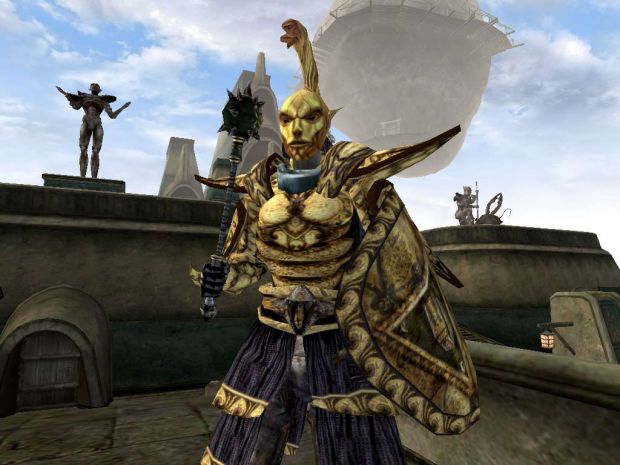
Guard of Vivec


Conclusion

Overall I would recommend this game to everyone regardless of your particular gaming tastes as it has something for everyone. The completely non-linear style to the game as well as the immense area to explore is a huge plus in my book. It really has the feel of an Everquest or Dark Ages of Camelot without all the hang-ups of forced grouping, other assjack players, and you can even save your progress. The game really never felt tedious to me, though I do have a strong dislike of those damnable cliff racers now, but that is easily worked around with a little in-game ingenuity and a little toy I like to call my Daedric Crescent Sword. On a scale from yokel to ubermensch, this has Nietzsche written all over it.

Translation : Go and buy this game !

Rating 9.1


8/19/2008

Games of Legend : Gothic II

Gothic 2 is a part of the Gothic franchise developed by Piranha Bites and published by Jowood . This game received lots of good reviews and such when it first appeared and for a good reason .


The graphic engine is the same that brought to life Gothic I , but has lots of improvements , many of these are visual or physical . The game brings a map two times larger that the map of it's predecessor , the map of the island of Khorinis . The attention for details is unmatched in any other game . Each object , building or NPC script has a spacial place in the game's big picture .

The player will find himself pretty much in the same position as he was at the begining of the first Gothic . But this time , Xardas is there to help you through the first hours of the game . In the game you will find the city of Khorinis which is the port city of the island . Everything that remains from the old settlements of the Valley Of Mines , is just the castle of the Old Camp which is now defended by a group of paladins and town militia .

The high grade of immersion that characterize the series is also present in Gothic 2 . During the day , merchants try to sell their goods , citizens talk about the latest news , master craftsmen work in their shops and guards patrol the streets or train in the barracks . In evening , people gather around camp fires , smoke , talk or cook some roasted meat . The colors , the sound and the natural way in which each NPC behaves offer an unprecedented feeling , like if you would be part of the game . Many NPC have names and are a part of the plot , because sooner or later they will give you quests . Another outstanding element of the game is the day-night circle , the weather system (sun , dynamic clouds , falling stars , rain , snow etc ) and the animal reign that behaves natural ( herbivores forage for grass or fruits , predators hunt , each animal is set in it's specific habitat ) .

The central idea in Gothic 2 is the dragon invasion , dragons that are served by ferocious lizardmen . On top of this terrible danger , the imminent orc conquest make things even worse .
The story is filed with unexpected events and flavored with action , thrill and a heap of adventure .

Even tho the game is from 2003 , the only thing that a true RPG fan could whine about are the graphics that aren't exactly Directx 10 , but regarding any other aspect the game is flawless .

Here are some pics from the game , in order for you to see the graphics .


Rating 9.1